Machines
Aircraft
Types and machines in context — not specifications for their own sake, but how each connects to squadrons and the fields they knew.
Machines
Types and machines in context — not specifications for their own sake, but how each connects to squadrons and the fields they knew.
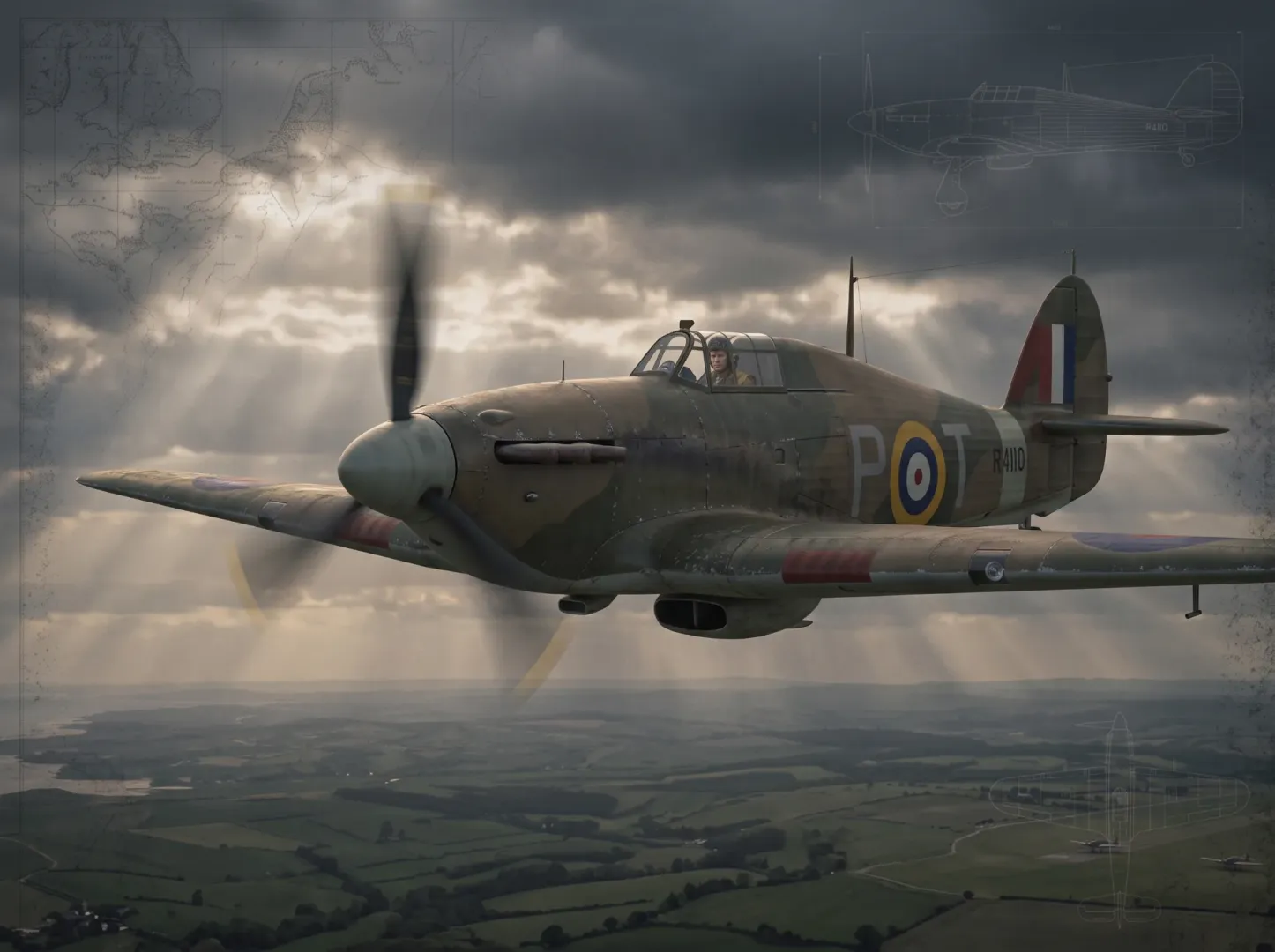
Aircraft
Air Superiority • Interception • Fighter Bomber · Hawker Aircraft Ltd
The Hawker Hurricane was one of two aircraft that won the Battle of Britain for the RAF — the other being the Supermarine Spitfire — and it bore the brunt of the fighting. Designed by Sydney Camm at Hawker Aircraft, the Hurricane was a sturdy, resilient fighter whose fabric-covered airframe and broad wings gave it exceptional manoeuvrability and a reputation for being able to absorb battle damage and bring pilots home.
When war broke out in September 1939, the Hurricane was already the RAF's most numerous fighter type. It equipped 19 squadrons at the outbreak of hostilities and was in action from the first day of the war, flying patrols over France and the English Channel. During the Battle of Britain, Hurricanes were responsible for destroying more enemy aircraft than any other type — around 55% of all Luftwaffe losses — despite being outnumbered by the more celebrated Spitfire. The reason was practical: the Hurricane could be mass-produced quickly, was easy to repair, and could operate from improvised grass strips if needed.
Hurricanes operated from virtually every major RAF fighter station in the south and east of England, including Biggin Hill and Northolt. At Biggin Hill, No. 32 Squadron and No. 249 Squadron were among the units that fought with Hurricanes throughout the Battle. The Hurricane's ability to absorb damage was legendary — many pilots returned to base with their aircraft literally held together by tape and willpower.
As the war evolved, the Hurricane found new roles. It was adapted as a fighter-bomber for operations in North Africa and the Mediterranean, where its ability to operate from rough desert airstrips made it invaluable. The Sea Hurricane — a navalised version with catapult spools and arrester hooks — operated from CAM ships and escort carriers, contributing to the Battle of the Atlantic.

.webp&w=3840&q=75)