Aircraft
Variants and Marks
Supermarine Spitfire
Image credit
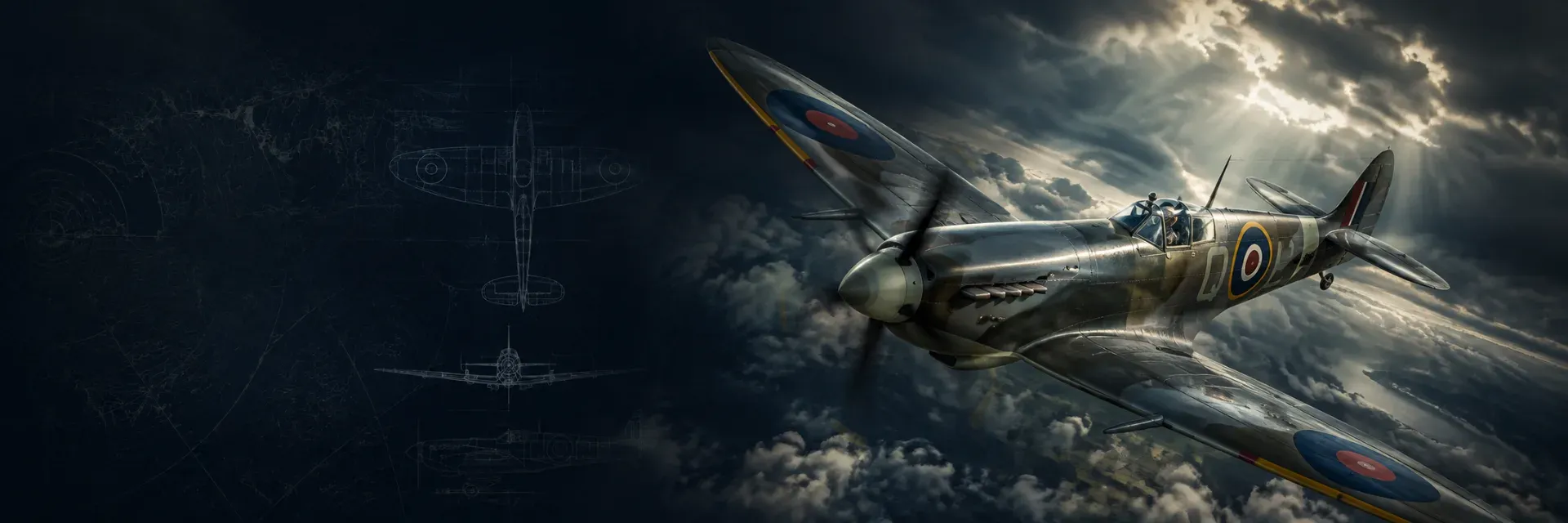
The Spitfire's evolution across more than twenty marks and forty variants — from the Merlin-engined Mk I of 1938 through the wartime Mk V and Mk IX to the Griffon-engined Mk XIV and the naval Seafire, a decade of continuous development that kept the airframe competitive from the Battle of Britain to Korea.
Editorial introduction
No other combat aircraft of the Second World War was developed as relentlessly as the Spitfire. Between the Mk I of 1938 and the Mk 24 of 1945, Supermarine produced more than twenty marks and some forty named variants, each responding to a new German fighter, a new role, or a new engine. The result was a single airframe that remained genuinely competitive for a decade — from the Battle of Britain through the high-altitude duels of 1942 and the escort and ground-attack work of 1944, to the final Griffon-engined marks that served until the 1950s. This page records that development family: how the variants were organised, what each was built to do, and what actually separated them.
Variant records
The RAF's mark system — Roman numerals for the basic marks, with letters for sub-variants — gives the Spitfire family its orderly appearance, but the reality was messier. A "mark" was not a single specification but a production series, and aircraft of the same mark often differed in engine, propeller, wing or armament as production ran. The Mk IX, for example, was rushed into service to counter the Focke-Wulf Fw 190 and went through numerous sub-variants with different Merlin engines, different wing types and different roles — fighter, bomber-reconnaissance, and fighter-bomber.
The record is further complicated by the parallel families. The PR (photographic reconnaissance) marks were built without guns, with extra fuel and a smooth, fast finish — derived from the same airframe but operationally a different aircraft. The Seafire, the naval carrier version, was a separate family again, with arrestor hooks, catapult spools and, from the Mk III, folding wings. Any honest count of "the Spitfire" therefore depends on which family you include: fighter marks, PR marks, or the Seafire.
Role
The Spitfire's roles multiplied as the war went on. It began as a pure interceptor — the role it was designed for, and the role in which it fought the Battle of Britain. From 1941 it added fighter-bomber work, carrying bombs and, later, rockets. The PR marks flew unarmed reconnaissance, photographing targets and bomb damage at high speed and high altitude, and became the RAF's most important strategic reconnaissance aircraft of the war. The Seafire operated from carriers, protecting the fleet and supporting amphibious landings from North Africa to the Pacific. The later Griffon marks, with their speed and climb, were used as high-altitude interceptors against the V-1 flying bomb and the jet fighters that followed. No other fighter of the era filled so many roles from one basic design.
Engine and configuration
The Spitfire's development is essentially the story of two engines. The Merlin marks — Mk I through Mk XVI — were powered by successive versions of the Rolls-Royce Merlin, the most important step being the two-stage supercharged Merlin 61 of 1942, which transformed the Mk IX's performance at altitude and restored the Spitfire's edge over the Fw 190. The Griffon marks, beginning with the Mk XII of 1942 and reaching full production with the Mk XIV, used the larger Rolls-Royce Griffon, a bigger, more powerful engine that drove a five-blade propeller and gave the later Spitfires their distinctive long nose and dramatically improved speed and climb.
Configuration changes tracked the engines. Early marks used two-blade fixed-pitch propellers, then three-blade variable-pitch units; the Griffon marks required four- and five-blade propellers, and the final marks used contra-rotating units. Wings varied between the standard, clipped (for low-altitude work) and extended (for high-altitude reconnaissance) tips, and armament grew from eight .303 machine guns through combinations of cannon and machine gun to four 20 mm cannon on the final marks. The fighter that ended the war shared its basic geometry with the one that began it, but little else.
Production period
The Spitfire was in continuous production for over a decade. The first production order was placed in June 1936, the Mk I entered RAF squadron service in August 1938, and the last airframe was delivered in 1948 — by which time the aircraft was being produced in versions barely recognisable as the same machine. Peak production came during the war years, with Supermarine's shadow factories at Castle Bromwich and elsewhere building the bulk of the total. In all, more than 20,000 Spitfires were built across all marks, with the Seafire adding a further two and a half thousand. The last Spitfire in RAF operational service, a PR Mk XIX, was not retired until 1957 — by then a museum piece in the eyes of many, but still flying reconnaissance missions nobody else could do as well.
Principal differences
The differences between marks can be grouped into four generations. The first — Mk I and Mk II — established the fighter: Merlin engine, eight-gun wing, the aircraft of the Battle of Britain. The second — Mk V and its immediate descendants — was the war's most numerous, a rugged development with the more powerful Merlin 45 series that fought through 1941 and 1942. The third — the Mk IX and Mk XVI — restored performance parity with the two-stage Merlin, and became the most significant of all: the Mk IX was produced in greater numbers than any other mark. The fourth — the Griffon marks, Mk XII through Mk 24 — were faster, heavier and more specialised, ending the line with a fighter that bore the same name as the 1938 original but was a different aircraft in almost every measurable way. Within each generation, the differences were smaller: an engine change, a wing type, a propeller, a role. But those small differences were what kept the Spitfire competitive, and they are what this record documents.