Airfields
Operations and Events
RAF Waddington
Image credit
From 5 Group's wartime bombing campaign to Cold War Vulcan readiness and today's Rivet Joint intelligence missions, Waddington has been at the sharp end of RAF operations for eight decades.
The bomber offensive, 1939–1945
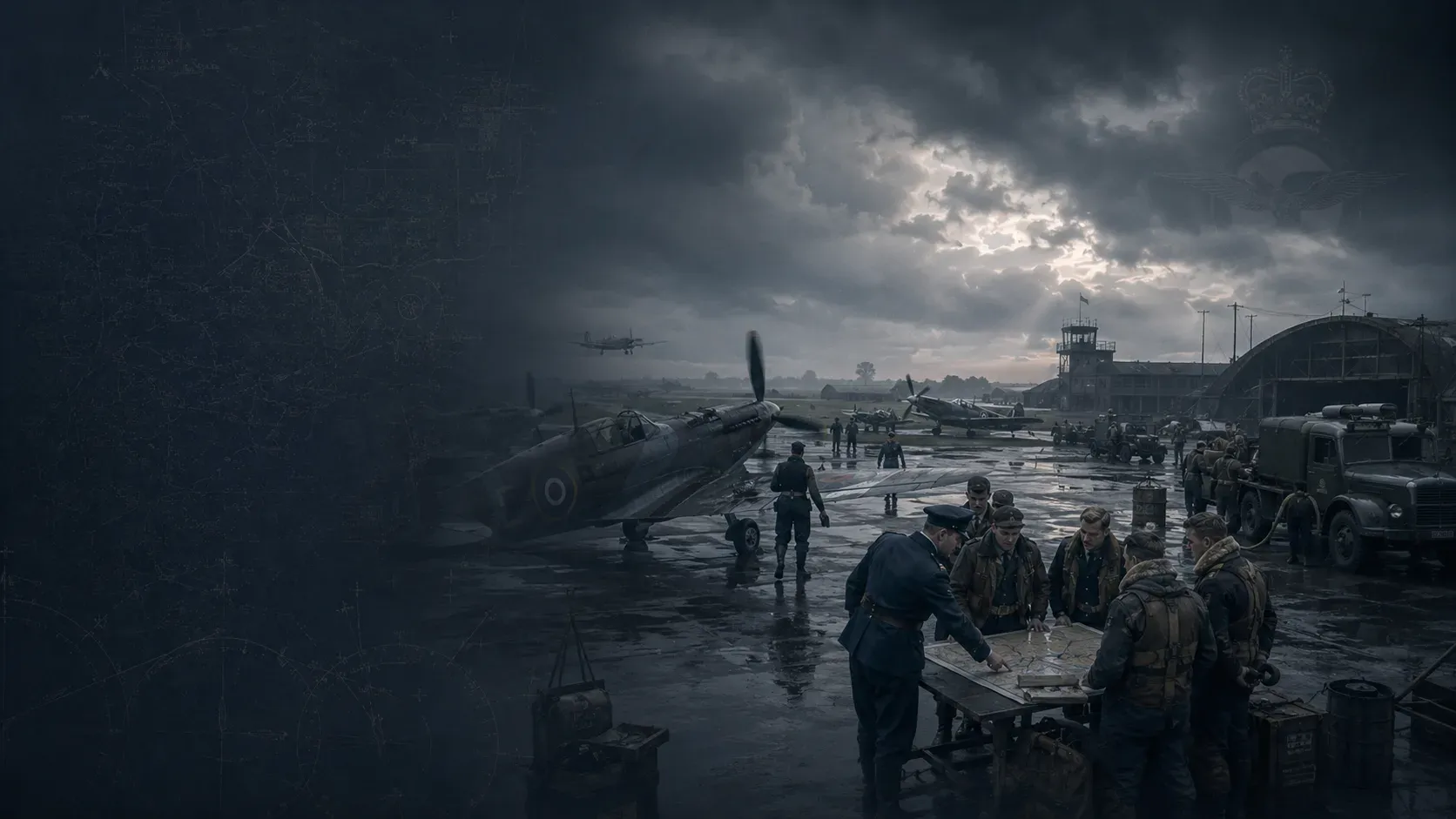
When war was declared in September 1939, Waddington's squadrons — Nos. 44 and 50 — were already on the operational roster with Handley Page Hampdens. The early war years were a grim education: daylight raids were abandoned after heavy losses, and the squadrons settled into night operations against German shipping, naval bases and industrial targets, often in weather that made finding the target a matter of navigation and nerve.
The station's place in Bomber Command history was fixed in March 1942. No. 44 (Rhodesia) Squadron flew the RAF's first operational Lancaster sortie, and the four-engined heavy bombers rapidly became Waddington's mainstay. The station's squadrons took part in the milestone raids of the campaign — the thousand-bomber raids of 1942, the Ruhr offensive, the firestorm raids on Hamburg, and the long, costly battle of Berlin through the winter of 1943–44. Waddington aircraft also flew in Operation Hydra, the raid on the German rocket research establishment at Peenemünde in August 1943, one of 5 Group's most important operations of the war.
None of this came cheap. Bomber Command's tour system meant a crew completing thirty operations was the exception, not the rule, and Waddington's loss boards filled accordingly. The names on the station's memorials — and the crew graves across Lincolnshire churchyards — are the truest measure of what the bomber offensive demanded of this airfield.
The station under attack
Waddington's own personnel knew the other side of bombing. As a busy, visible bomber station near the coast, it was a natural target for the Luftwaffe, and German raids struck the airfield on several occasions, most seriously in 1941 and again during 1942. Hangars were wrecked, aircraft on dispersals were destroyed, and station staff as well as aircrew were killed. The raids forced Waddington's ground crews to work through the same danger their aircrews faced over Germany — and the airfield's rapid repair and return to operations became part of its wartime record.
Cold War readiness: the V-force years
With the Vulcan, Waddington entered the strangest era of its operational history: the busiest peacetime flying the RAF had ever known. From 1957, Nos. 44, 50 and 101 Squadrons operated the delta-winged bombers from the station, with No. 101 Squadron carrying the Blue Steel stand-off missile. The operational pattern was one of constant, silent readiness — aircraft held at high alert, crews cycled through cockpit readiness, and a nuclear strike plan rehearsed in the certain knowledge that it was meant never to be used.
The Cold War readiness was real, not ceremonial. Vulcan crews from Waddington flew training sorties that simulated the profiles they would have flown in earnest, and the base was repeatedly exercised against the threat of a Soviet first strike. It was a life of enormous technical skill applied to a job everyone hoped would never happen.
Black Buck and the Falklands
The V-force's moment of actual war came in 1982, and Waddington was at its centre. Vulcan XM607, a Waddington-based aircraft of No. 101 Squadron, flew Operation Black Buck — the extraordinary long-range bombing raid on Port Stanley airfield in the Falkland Islands, launched from Ascension Island and sustained by a chain of Victor tankers. At the time it was the longest bombing mission ever flown, and it remains one of the most audacious operations in RAF history. XM607 returned to Waddington after the war and stands today as the gate guardian by the main entrance — the station's most visible link to its operational past.
The ISTAR era
The end of the Vulcans in 1984 might have closed Waddington's story. Instead, the station was reinvented as the RAF's centre for intelligence, surveillance and reconnaissance — a role that has kept it operationally busier than most bomber eras ever did.
From 1991 the E-3D Sentry of No. 8 Squadron flew airborne early warning missions over the Balkans, Iraq and Afghanistan. No. 51 Squadron's Nimrod R1s gathered signals intelligence over the same conflicts, and the Sentinel R1 joined the line in time for operations over Libya in 2011. Today the RC-135W Rivet Joint — arguably the most capable intelligence aircraft in the RAF inventory — flies missions over the Middle East and beyond, supported by the Shadow R1 and, increasingly, the Protector remotely piloted aircraft. The operational tempo is continuous, the crews deploy constantly, and the results rarely make the news — which is, for an intelligence unit, the whole point.
The airshow years
Alongside the operations, Waddington built a public tradition that made it one of the best-known RAF stations in Britain. From the mid-1990s, the Waddington International Airshow became one of Europe's largest military airshows, drawing hundreds of thousands of visitors to the Lincolnshire countryside. The Vulcan's post-retirement appearances — including the restored XH558 — were among its most emotional moments, a direct link between the crowds on the ground and the station's bomber heritage. The airshow's final staging in 2015 brought that particular tradition to an end, but it cemented Waddington's place in the affections of generations of enthusiasts.